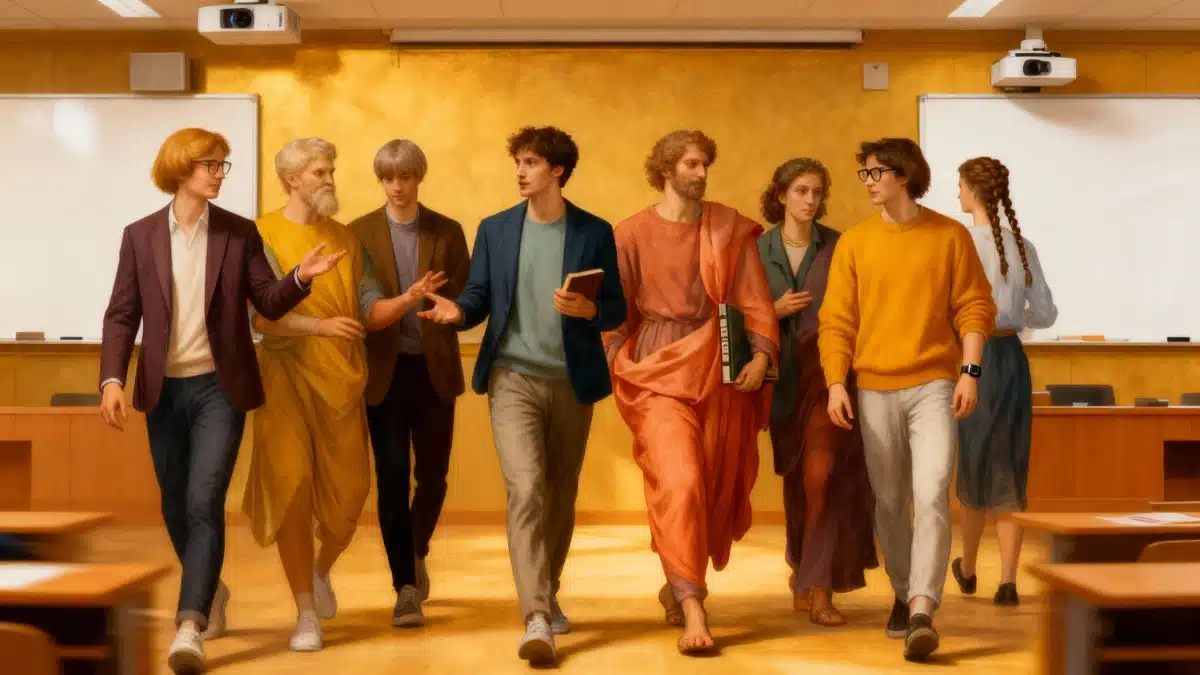
The West’s Troubled Love Affair with Beauty
Barilier argues that Europe’s critical spirit—a hallmark of its identity—has ironically led to a kind of self-defeat.
« Europe has stopped loving itself because, having looked itself in the eye, it deemed itself guilty of too many crimes. In the name of this same critical spirit, we’ve abandoned our sense of transcendence and the intuition that what is beautiful may possess the power of truth. »
He quotes Klaus Mann, lamenting Europe’s infidelity to its dual heritage: Athens (the Acropolis) and Jerusalem (Golgotha). According to Barilier, it is within this rich, foundational heritage—and not outside of it—that Europe should seek new strength.
He quickly points out, however, that the Renaissance and Enlightenment deserve their due, even if their own roots reach further into the past, shaping essential Western concepts like personhood and democracy. Ideas which, as Barilier warns, are currently at great risk worldwide—and whose preservation may depend largely on Europe.
The Paradox of Beauty, Truth, and Goodness
European thinking about beauty cannot be separated from the ideas of truth and goodness.
« Since Plato, we are incapable of considering beauty for its own sake, without tying it to the good and the true. »
Is this lamentable, or uniquely Western? Barilier contends that other civilizations either consider beauty an independent, pure, almost unthinkable force (as in East Asia), or so closely intertwine it with good and true—like some Muslim mystics—that it merges with the Divine and becomes ineffable.
Platonism, he says, sets up a unity of beauty, the good, and the true—but not their sameness. Barilier offers examples from European writers and thinkers, showing how grappling with beauty inevitably leads to deep, passionate reflection on goodness and truth. He doubts that such precise lines of thought can be found elsewhere—although he admits, with a smile, that he may be showing some ignorance there.
Russia, Redemption, and the Mystery of Beauty
The famous phrase from Dostoevsky’s Prince Myshkin— »beauty will save the world »—gets a thorough inspection. Barilier calls it admirable, but ambiguous: after all, « salvation » is a deeply Christian concept, and Myshkin seems to attribute to physical beauty the qualities of a Christ-like sacrifice.
Elsewhere in Dostoevsky, characters like Versilov or Stavrogin echo similar themes: the idea of Russia saving a dying European humanity. Yet, as Barilier notices, Dostoevsky draws inspiration for images of innocence not from Russian sources, but from works like Claude Lorrain’s « Landscape with Acis and Galatea »—a resolutely Mediterranean, luminous scene. So, paradoxically, the tragic Russian vision of salvation ultimately points towards a more Mediterranean, even pagan, happiness. The Christ figure is sometimes replaced by the face of a woman. What a beautiful tangle of paradoxes!
Can Beauty Counter Our Contemporary ‘Disenchantment’?
Barilier reveals that his book’s original title was simply « Europe and Beauty ». His aim was modest yet vital: to explore Europe’s unique relationship with beauty—focusing on works of European art—as a way, if not to save civilization, at least to stave off despair. He quickly distances himself from any simplistic « aesthetic worldview. » Instead, his central thesis is that the contemplation of beauty reignites our sense of what is true and good, illuminating the world in a distinctively Platonic way.
He studies literary works—including Gogol’s extraordinary « Nevsky Prospect »—to show how even deceptive beauty provokes rich meditation on human nature. But, as Barilier warns, if we could easily separate beauty from truth and goodness, the moral conundrums posed by Céline’s artistry (or, let’s say, a Nazi playing Mozart with feeling) would dissolve. It’s precisely our inability to separate them that causes us such disquiet—an « ontological scandal. » Céline’s art, he says, is not beauty placed next to evil, but beauty inhabited by it; « death’s blood flows in beauty’s veins. »
Beauty, Religion, and the Question of Meaning
Is the waning of religion connected to a loss of beauty? Barilier believes so: religion, like art, is driven by an intuition of transcendence—a mysterious force that gives life meaning. He sees in Baudelaire’s restless question to Beauty— »Do you come from the deep sky, or rise up from the abyss? »—an acknowledgment that true beauty is never merely superficial, but contains the mysterium tremendum at its core.
He even goes as far as to claim that the feeling for beauty precedes, encompasses, and overflows the religious—because, in his eyes, it is purer and beyond any single definition.
Beauty Amid Evil: The Last Refuge?
Barilier devotes passionate pages to figures like Céline and Wagner, insisting the real question is not separating the artist from the art, but grappling with how evil or destructive fascination can live within the work itself. He concludes with a telling example: survivors of the twentieth-century’s worst horrors, such as Vassili Grossman and Varlam Shalamov, both found themselves moved to tears by Raphael’s Sistine Madonna.
« Before this pure work of beauty, these men—without conferring—saw, quite literally, the human suffering they’d known at Stalingrad or in the camps. Raphael’s art irresistibly recalled to them humanity and kindness. Beauty was an answer to suffering. »
Barilier is convinced that the greater one’s experience of life’s suffering, the more precious beauty becomes. The Sistine Madonna did not « re-enchant » Grossman or Shalamov’s world—but it did save them from despair.
The mystery of beauty remains, as one reader remarks: something frozen, or simply strange, that stands apart from reality—even as it stirs the mind and imagination. Beauty, then, may never fully satisfy, but it keeps us dreaming, thinking, and, just maybe, hoping.

Jack Mercer is a writer with a passion for American culture and everyday style. After spending years exploring the country’s hidden gems and fashion scenes, he found his voice sharing stories that celebrate the authentic spirit of modern America. When he’s not writing, you’ll find him hunting for vintage denim or enjoying a good bourbon on his front porch.